In Vitro Fertilization

test tube baby IVF

IVF is an assisted reproductive technology in which eggs and sperm are fertilized and embryos are cultured in a laboratory before an embryo is transferred into the uterus to improve the chance of pregnancy.

CHAPTER 01

IVF IVF

In vitro fertilization (IVF) is an assisted reproductive treatment in which eggs and sperm are fertilized outside the body and cultured into embryos before transfer into the uterus. The physician tailors the ovarian stimulation protocol to ovarian reserve, age, and individual circumstances.

Indications
  • Fallopian tubes severely blocked
  • severe endometriosis
  • severe male infertility
  • Artificial insemination failed many times
  • Old age or reduced ovarian function
CHAPTER 02

Focus on organizing

01

egg retrieval surgery

Performed under ultrasound guidance with intravenous anesthesia in approximately 15-30 minutes.

02

embryo culture

After egg retrieval, observe fertilization and division, and culture until day 3 or day 5.

03

embryo implantation

Arrange fresh or frozen embryo implantation according to the endometrium and embryo conditions.

CHAPTER 03

Treatment process

D2

Blood tests, ultrasound, and ovarian stimulation medication

Assess ovarian function and begin injectable ovarian stimulation medication.

D7-12

Ovulation induction and follicle monitoring

1. Monitor follicle growth and maturity with ultrasound and blood tests

2. Use a GnRH antagonist

Trigger injection: administered 34-36 hours before egg retrieval

D13-15

Egg retrieval and fertilization

1. Transvaginal ultrasound-guided egg retrieval under intravenous sedation

2. Collection of a fresh semen sample

3. Fertilization

Embryo culture: embryos are cultured and frozen 3-7 days after egg retrieval

Fresh embryo transfer: progesterone is given after egg retrieval, followed by embryo transfer on day 3-5

D26

Pregnancy test

A blood test confirms the result 7-9 days after transfer.

CHAPTER 04

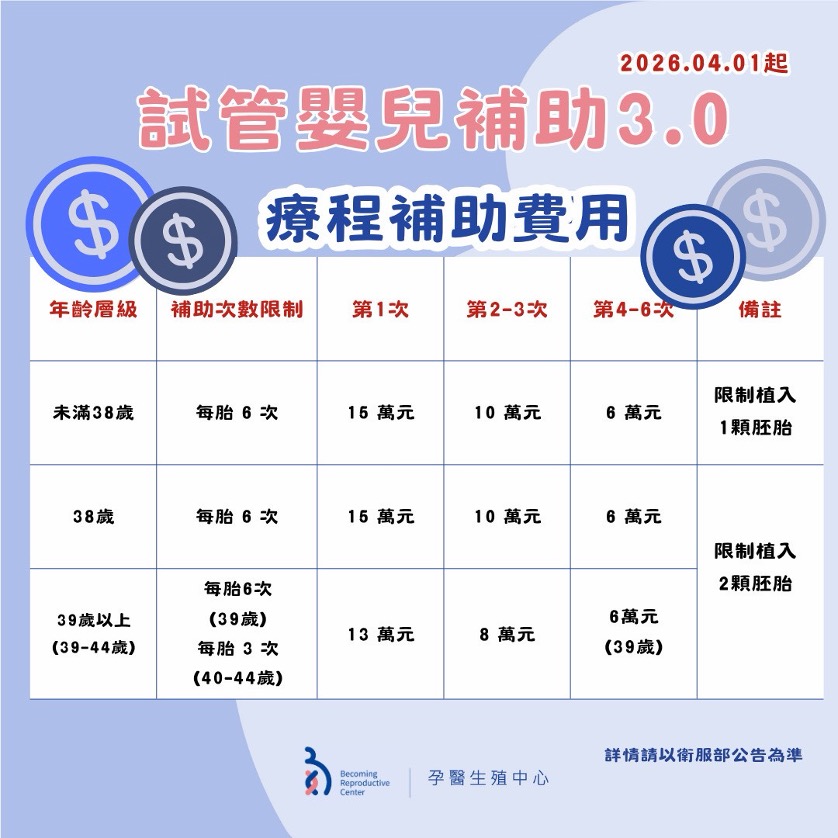
Subsidy Information

Subsidy Information
CHAPTER 05

FAQ

QHow should I choose between IUI and IVF?

1. Situations suitable for intrauterine insemination (IUI)

(1). Patent fallopian tubes

(2). Mild male-factor sperm abnormalities

(3). Difficulty with intercourse

(4). Ovulatory dysfunction

(5). Mild endometriosis

(6). Unexplained infertility

If IUI has not succeeded after 2-3 attempts in these situations, IVF should be considered.

2. Situations suitable for IVF:

(1). Severe fallopian tube blockage

(2). Severe endometriosis

(3). Severe male-factor sperm abnormalities

(4). Multiple failed IUI attempts

(5). Advanced age or premature ovarian aging

(2). Severe endometriosis

(3). Severe male-factor sperm abnormalities

(4). Multiple failed IUI attempts

(5). Advanced age or premature ovarian aging

QIs the IVF success rate high?

Statistics released by Taiwan's Health Promotion Administration in 2025 show that pregnancy and live-birth rates decline as the age of women receiving treatment increases after age 34, with a marked drop in success among women over 40. For 2023 treatment cycles, the cumulative pregnancy rate was 44.6% and the live-birth rate was 49.7%. Among women over 40 receiving IVF, the pregnancy rate was 47.2% with frozen embryo transfer versus 29% with fresh embryo transfer (from assisted reproduction statistics released by the Health Promotion Administration in December 2025). During a treatment cycle, ovarian stimulation medication can affect endometrial receptivity and reduce implantation rates with fresh embryo transfer. Frozen embryo transfer avoids this issue and may provide better pregnancy and live-birth rates.

QCan I work during treatment?

Yes. You can work normally during treatment while attending scheduled follow-up visits and egg retrieval. Taking the day off to rest on the day of egg retrieval is recommended.

Take the next step.

Ready to take the first step towards IVF?

Becoming team helps you plan the most suitable treatment plan.

IVF IVF | Becoming Reproductive Center | Premier IVF & Comprehensive Fertility Care