Uterine Fibroid Removal Surgery: Which Type Is Right for You?
💡 In gynecologic surgery, myomectomy is a common treatment for uterine fibroids.
The goal is to remove the fibroids while preserving the uterus, making it especially suitable for patients who still have fertility needs.
㊙️ Below are the different types of myomectomy and their features:
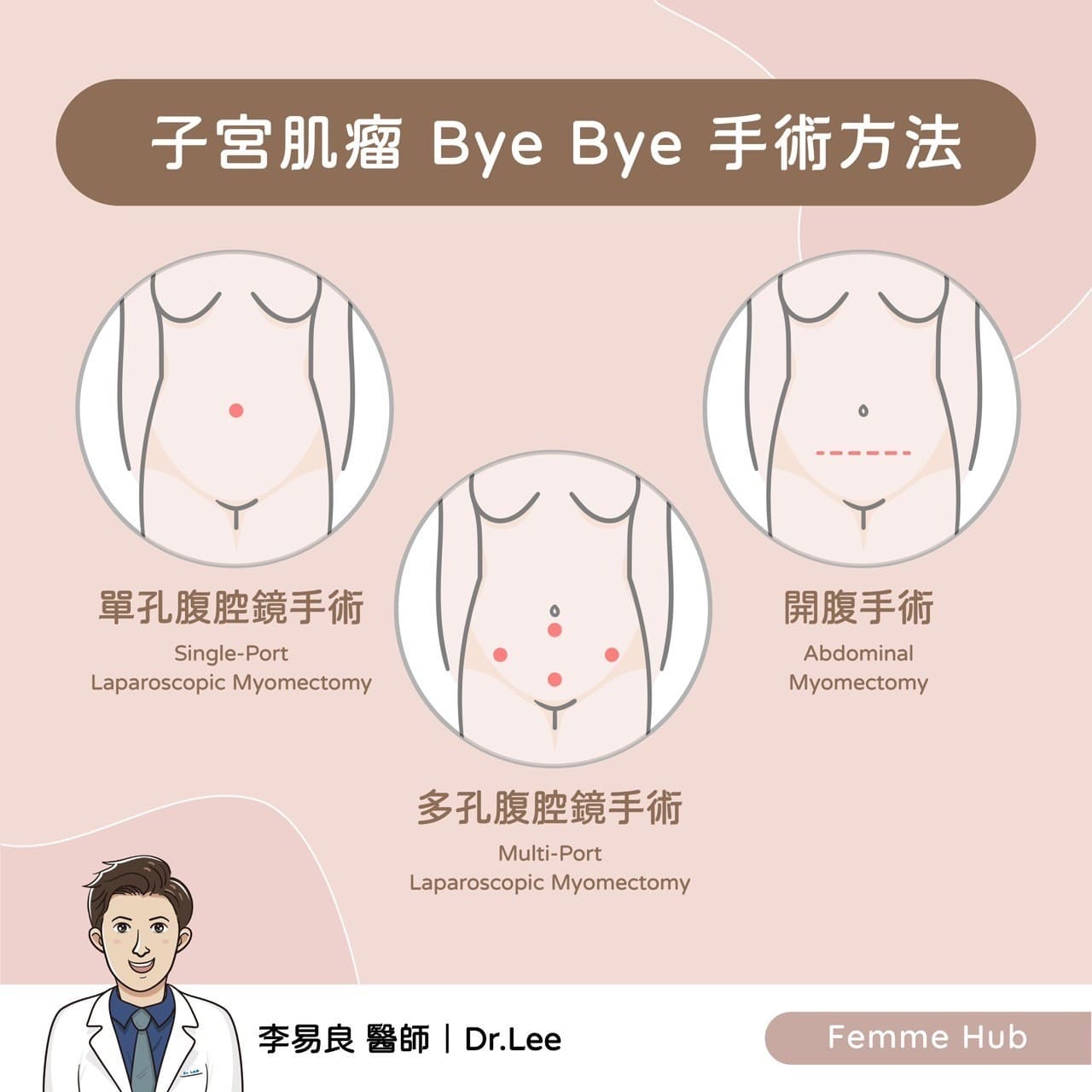
- 1.Single-Port Laparoscopic Myomectomy
This procedure is performed through only one incision located at the belly button, about 1–2 cm in size, using laparoscopic surgery.
There is only one hidden incision at the umbilicus, so the cosmetic result is better.
It causes less trauma and milder postoperative pain.
However, the operating space is limited, and the technical difficulty is higher.
It is suitable for young patients who have higher cosmetic expectations and relatively simple fibroids.
- 1.Multi-Port Laparoscopic Myomectomy
This procedure is performed through 3–4 small abdominal incisions, each about 0.5–1 cm.
The operation is more flexible, with a clear surgical view, and it can handle more types of fibroids and more complex cases.
It is relatively minimally invasive and allows faster recovery.
However, it requires multiple incisions, so the cosmetic result is not as good as single-port surgery.
It is suitable for patients with multiple fibroids, complex fibroid locations, or those requiring precise dissection.
- 1.Abdominal Myomectomy
This procedure involves making an abdominal incision of about 3–10 cm, opening the uterus, and directly removing the fibroids.
It provides a wide surgical field and is suitable for complex fibroids.
However, the wound is larger, recovery time is longer, and postoperative pain is more obvious.
It is suitable for patients with many fibroids, larger lesions such as around 10 cm, or those with previous surgical history and adhesions.
- 1.Vaginal Natural Orifice Transluminal Endoscopic Myomectomy
vNOTES Myomectomy
This procedure enters the abdominal cavity through the vagina and uses laparoscopic equipment to remove fibroids.
There is no abdominal incision, the cosmetic result is good, and recovery is fast.
However, it requires advanced surgical skill and is suitable only for selected patients.
- 1.Hysteroscopic Myomectomy
This procedure is performed through the vagina using a hysteroscope, with no abdominal incision and faster postoperative recovery.
However, it is only suitable for fibroids inside the uterine cavity and cannot treat subserosal or intramural fibroids.
- 1.Robotic-Assisted Myomectomy
This procedure uses robotic assistance to remove fibroids, similar to laparoscopic surgery.
It is suitable for complex fibroids requiring higher precision.
It offers high accuracy, stable visualization, and less intraoperative blood loss.
However, it is more expensive.
- 1.Ultrasound-Guided High-Intensity Focused Ultrasound
HIFU, High-Intensity Focused Ultrasound
This treatment uses focused ultrasound heat energy to target the fibroid and destroy fibroid tissue.
It is non-invasive, does not require anesthesia, and allows fast recovery.
However, it is more expensive, and the rate of fibroid ablation after treatment may vary depending on individual constitution.
‼️👨🏻⚕️ Each surgical method has its own advantages and disadvantages, as well as limitations related to lesion location and size.
It is important to discuss with a professional gynecologist in order to achieve personalized treatment.
BRCIVF wishes your dreams come true!