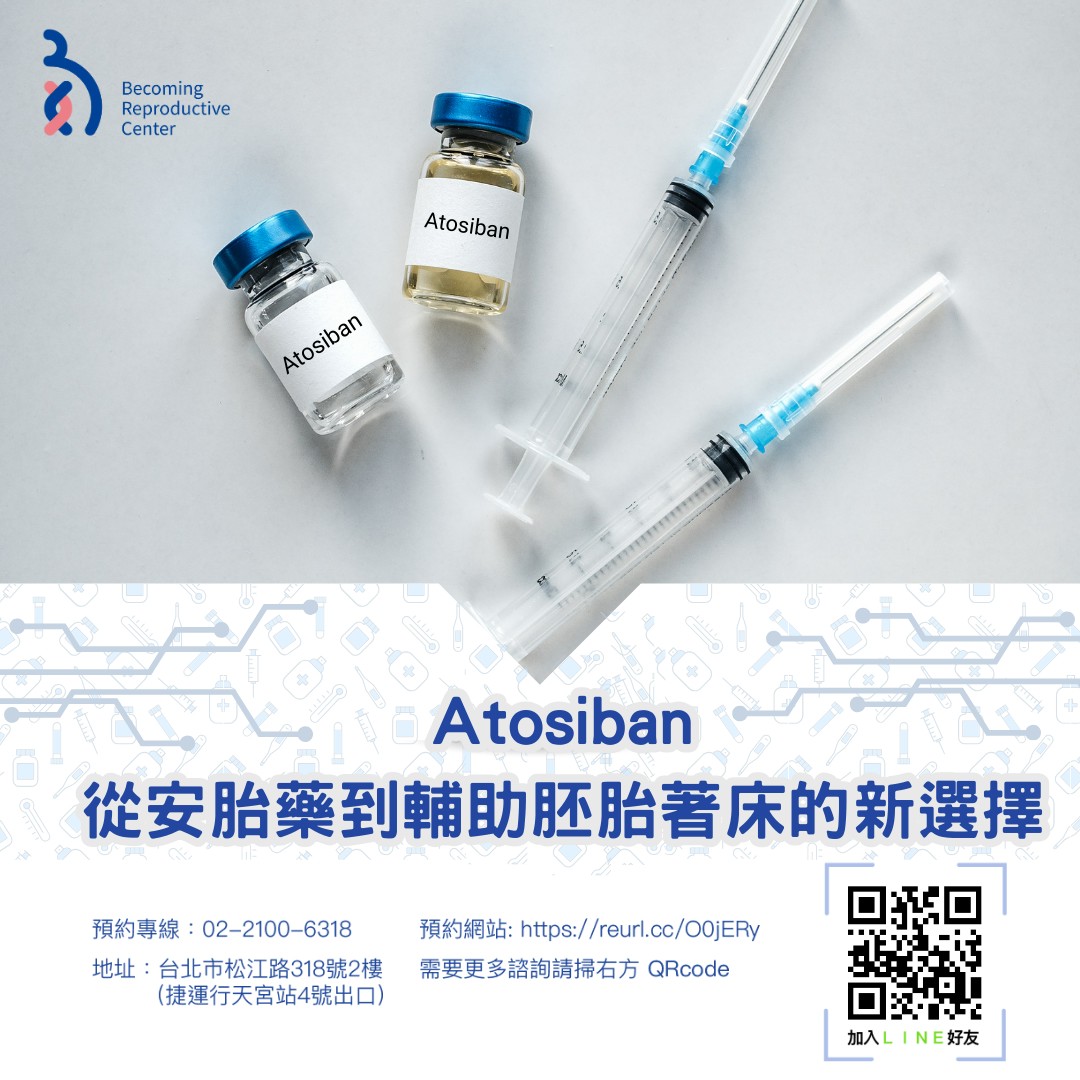
🔬 Atosiban: A New Option from Delaying Preterm Birth to Supporting Embryo Implantation
Atosiban is an antagonist of oxytocin and vasopressin V1a receptors. It was originally used to delay preterm birth, and in recent years, it has also been applied in the field of assisted reproduction.
Studies have found that about 30% of IVF patients experience increased uterine contractions during embryo transfer. Frequent uterine contractions may prevent embryos from implanting successfully.
By inhibiting uterine myometrial tension and contraction frequency, Atosiban may help stabilize the intrauterine environment, improve endometrial receptivity, and further increase embryo implantation rates and clinical pregnancy rates.
According to systematic reviews and meta-analyses of three key studies in recent years, Atosiban may indeed have a positive effect on clinical pregnancy rates after embryo transfer, especially in patients with repeated embryo implantation failure, RIF.
Another meta-analysis conducted by Juan Enrique Schwarze and colleagues, which included both randomized and non-randomized trials, also showed that Atosiban may improve overall embryo transfer outcomes.
Among all included randomized controlled trials, Atosiban significantly improved clinical pregnancy rates, with an OR of 1.47 and a 95% CI of 1.18–1.82.
However, the Cochrane systematic review by Craciunas et al., 2021, noted that current evidence is still insufficient to confirm the final effect of Atosiban on live birth rates and miscarriage rates.
In the analysis, the live birth rate with Atosiban ranged from 33% to 47%, compared with 38% in the control group. The miscarriage rate decreased from 7% to 5%–11%, but the difference did not reach statistical significance, although a positive trend was observed.
In addition, endometrial receptivity also affects the success of embryo implantation.
For patients with endometriosis without concomitant adenomyosis, Atosiban may effectively increase embryo implantation rates and clinical pregnancy rates.
In summary, Atosiban appears to have a clear positive effect in patients with repeated embryo implantation failure, improving clinical pregnancy rates and implantation success rates.
For patients without a diagnosis of RIF, however, current supporting evidence remains limited. Its effectiveness may depend on the degree of uterine contractions and other individual factors.
Therefore, in clinical use, individualized evaluation and use in high-risk groups are recommended.
Atosiban may be considered in the following situations:
Difficult or time-consuming embryo transfer
Obvious uterine contractions
Repeated implantation failure
Patients with endometriosis
However, routine use is not recommended.
For those who feel worried or nervous about embryo transfer, it is recommended to discuss with a specialist in advance and evaluate whether Atosiban is suitable.
References:
Juan Enrique Schwarze, Javier Crosby, Antonio Mackenna. Atosiban improves the outcome of embryo transfer. A systematic review and meta-analysis of randomized and non-randomized trials. JBRA Assisted Reproduction 2020;00(0):00-00. doi: 10.5935/1518-0557.20200016
Ruxin Wang, Haixia Huang, Yong Tan, Guicheng Xia. Efficacy of atosiban for repeated embryo implantation failure: A systematic review and meta-analysis. Front Endocrinol (Lausanne). 2023 Mar 23;14:1161707. doi: 10.3389/fendo.2023.1161707
Laurentiu Craciunas, Nikolaos Tsampras, Martina Kollmann, Nick Raine-Fenning, Meenakshi Choudhary. Oxytocin antagonists for assisted reproduction. Cochrane Database Syst Rev. 2021 Sep 1;2021(9):CD012375. doi: 10.1002/14651858.CD012375.pub2
Ye He, Huan Wu, Xiaojin He, Qiong Xing, Ping Zhou, Yunxia Cao, Zhaolian Wei. Administration of atosiban in patients with endometriosis undergoing frozen–thawed embryo transfer: a prospective, randomized study. Fertility and Sterility. Volume 106, Issue 2, p416–422, August 2016.
BRCIVF wishes your dreams come true!