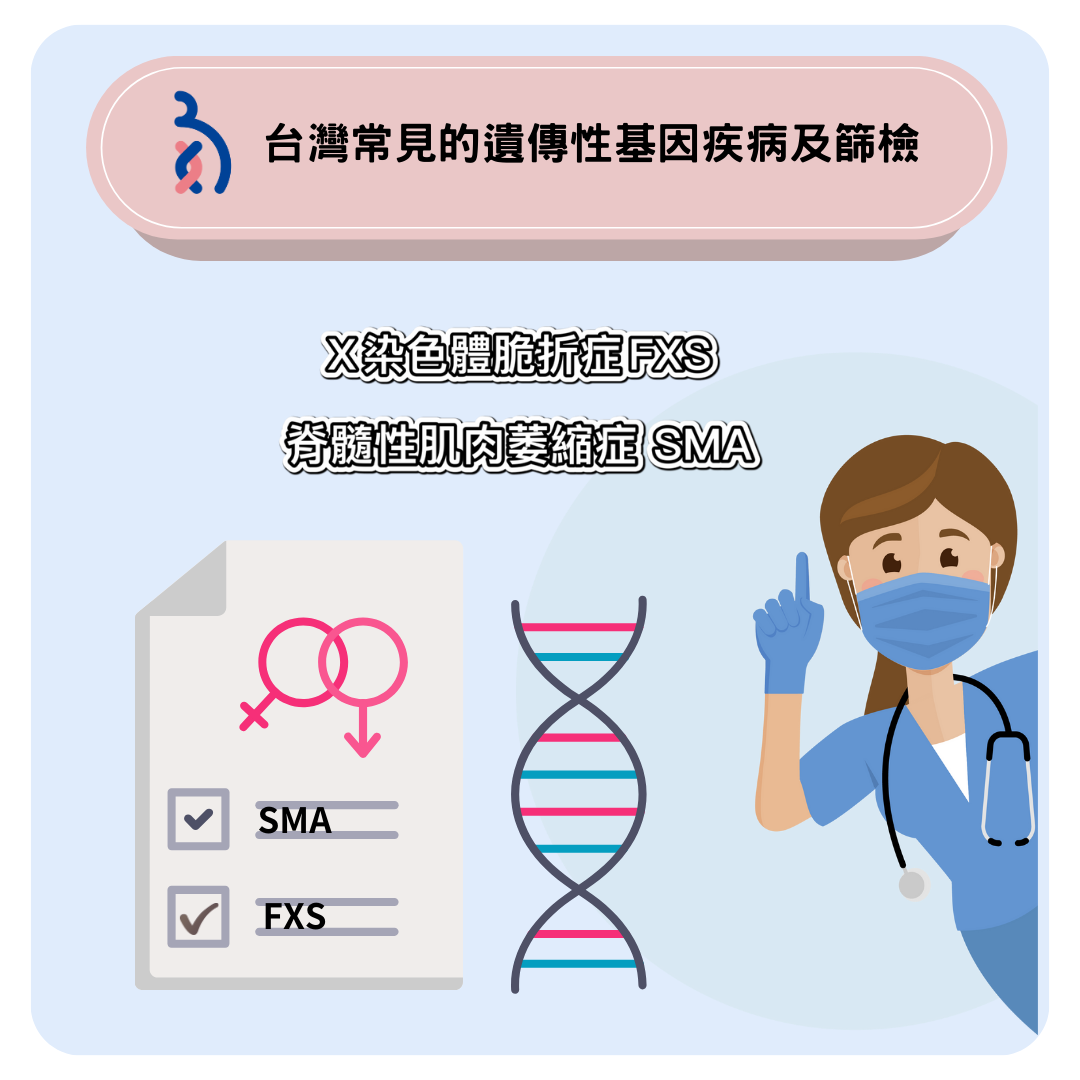
Do You Know What FXS and SMA Are?
Parents who are looking forward to having children naturally worry about their baby’s health. Safety and normal development are always the top priorities.
Today, nursing consultant Wei-Heng Tsai introduces common hereditary genetic diseases in Taiwan and the importance of screening.
Fragile X Syndrome, FXS, is one of the most common inherited causes of intellectual disability.
In Taiwan, approximately 1 in 260 women is a carrier.
Patients have a fragile breakpoint at the end of the long arm of the X chromosome, which is how the condition gets its name.
This disease is hereditary and belongs to sex chromosome-linked genetic disorders.
Causes and inheritance
Everyone has the FMR1, Fragile X mental retardation 1, gene.
In patients with FXS, mutation of the FMR1 gene causes an abnormal increase in the number of CGG trinucleotide repeats. As a result, the body cannot produce the FMRP protein, which affects brain development and leads to intellectual disability.
Because this condition is caused by mutation of the FMR1 gene on the X chromosome, if the mother is a carrier and carries a baby girl, the baby has two X chromosomes.
Even if one X chromosome carries the mutation and does not function normally, the other X chromosome can still provide support. Therefore, symptoms in girls are generally milder.
In contrast, if the baby is a boy, he has only one X chromosome. Once that X chromosome carries the mutation, the chance of developing the disease is much higher.
Symptoms
Studies have shown that patients with Fragile X Syndrome do not always have the same features or symptoms. However, some symptoms are commonly seen, and symptoms in females are usually milder than in males.
Because this is a sex chromosome-linked disorder, affected young children often do not look different in early childhood, making it difficult to identify. Most patients are usually diagnosed around the age of 3.
In addition to intellectual disability, affected individuals may have varying degrees of physical features, including a large forehead, large ears, and a prominent jaw.
Behavioral symptoms may include emotional instability, delayed language development, difficulty concentrating, hyperactivity, autism-like features, and difficulty interacting with others.
Because the physical features are often not obvious, clinical diagnosis can be more difficult. In addition, female carriers rarely show symptoms clinically, so this condition often appears repeatedly within families.
Who should be tested?
The American College of Obstetricians and Gynecologists recommends genetic counseling and prenatal Fragile X Syndrome screening for the following groups:
Those with a family history of Fragile X Syndrome
Those with a family history of unexplained intellectual disability or autism
Those with a family history of unexplained ataxia or tremor disorders
Women with a family history of early menopause or primary ovarian insufficiency
Pregnant women who are concerned that they may be carriers
When the mother is a carrier and prenatal diagnosis is needed for the fetus
Children suspected of being affected who need genetic confirmation
Spinal Muscular Atrophy, SMA, is an autosomal recessive genetic disease.
In SMA, the spinal cord loses important cells that control muscle movement and strength. It is a motor neuron degenerative disease that causes muscles to gradually become weak, eventually leading to muscle atrophy.
Patients with SMA have completely normal intellectual development. However, the age of onset can range from birth to adulthood.
The disease can affect swallowing, breathing, and mobility, leading to serious limitations in daily life.
What is Spinal Muscular Atrophy?
SMA occurs when the spinal cord loses important cells that control muscle movement and strength.
It is a motor neuron degenerative disease that causes progressive muscle weakness and eventually muscle atrophy.
Based on age of onset, disease severity, and the extent of muscle involvement, SMA is divided into three types.
Type 1 Spinal Muscular Atrophy
Werdnig-Hoffmann Disease, severe type
Symptoms usually appear within six months after birth.
Infants may show severe hypotonia and weakness in the limbs and trunk, loss of tendon reflexes, inability to swallow, and difficulty breathing.
Most infants develop respiratory failure and die during infancy, usually before about two years of age.
Type 2 Spinal Muscular Atrophy
Dubowitz Disease, intermediate type
Between six months and one and a half years after birth, patients begin to develop symmetrical weakness in the proximal muscles of the lower limbs, leading to an inability to walk or stand.
The upper limbs may occasionally be affected, causing hand tremors.
Head muscles are usually less affected, and normal facial expressions may be preserved.
A small number of patients may die during childhood due to infections. However, most patients can live into adulthood with external medical support and care.
Type 3 Spinal Muscular Atrophy
Kugelberg-Welander Disease, mild type
The age of onset can range from one and a half years old to adulthood.
It usually presents as mild weakness in the proximal muscles of the limbs, causing only mild inconvenience during activities such as running or climbing stairs.
Patients with this type can usually survive long term.
Causes
SMA is mainly caused by gene mutations.
The affected region is located on the long arm of chromosome 5, involving a gene called the survival motor neuron gene, SMN1.
About 95% of patients with Spinal Muscular Atrophy have a large deletion or conversion in the SMN1 gene.
A small number of patients who do not have a large deletion or conversion in SMN1 may have smaller mutations in the SMN1 gene that cause the disease.
Most healthy individuals have two or more copies of the SMN1 gene. Carriers have only one SMN1 gene, while affected patients do not have any normal SMN1 gene.
In Taiwan, about 1 in 50 people is a carrier of SMA.
It is the second most common autosomal recessive genetic disease in Taiwan, after thalassemia.
Therefore, couples preparing for pregnancy are advised to undergo carrier screening for these diseases before starting IVF treatment. This helps with planning the next steps of fertility treatment and supports the goal of having a healthy child.
References: Genesis Genetics Asia, Sofiva Genomics
BRCIVF wishes your dreams come true!